
The Body-Mind Connection: What Research Reveals
Have you ever noticed how your heart races before your mind even registers danger? Or how your shoulders tense when you think about a stressful situation? Your body is processing information faster than your conscious thoughts—and this holds the key to understanding why traditional talk therapy sometimes isn't enough.
As a Certified Clinical EFT Practitioner specializing in nervous system regulation and trauma therapy, I've witnessed how combining traditional therapy with body-based approaches like EFT tapping creates deep, lasting emotional healing. While talk therapy helps us understand our trauma mentally, it often can't access what's stored in our nervous system through emotional distress and anxiety patterns.
"The body keeps the score."
— Dr. Bessel van der Kolk
This isn't just a powerful phrase—it's backed by solid research. In his groundbreaking work, van der Kolk (2014) demonstrates that emotional experiences leave measurable imprints on our nervous system, hormone levels, and even gene expression. Studies now show that trauma can actually alter our DNA, with effects that can be passed down through generations (Yehuda et al., 2021).
Many clients who struggle with anxiety, emotional overwhelm, or chronic stress have spent years trying to "think" their way out. They've read all the books, practiced positive affirmations, and gained insight in therapy. Yet when a triggering moment arises, their body still reacts automatically—almost like nothing's changed.
This biological reality explains why purely cognitive approaches may only address part of the healing equation. One landmark study found that EFT reduced cortisol levels by 43% after just one hour of treatment (Church et al., 2012), while a comprehensive meta-analysis of 23 randomized controlled trials showed that body-based interventions, including EFT, produced significantly better outcomes for anxiety and trauma than cognitive methods alone (Bach et al., 2019).
In my previous post, Feeling Stuck? The Breakthrough Isn't in Your Mind— It's in Your Body, I introduced the concept that managing anxiety and overwhelm requires more than mindset shifts—it requires working directly with your body's wisdom through bottom-up approaches like EFT Tapping.

Table of Content
- The Body-Mind Connection: What Research Reveals
- The Two Paths to Change: Top-Down vs. Bottom-Up
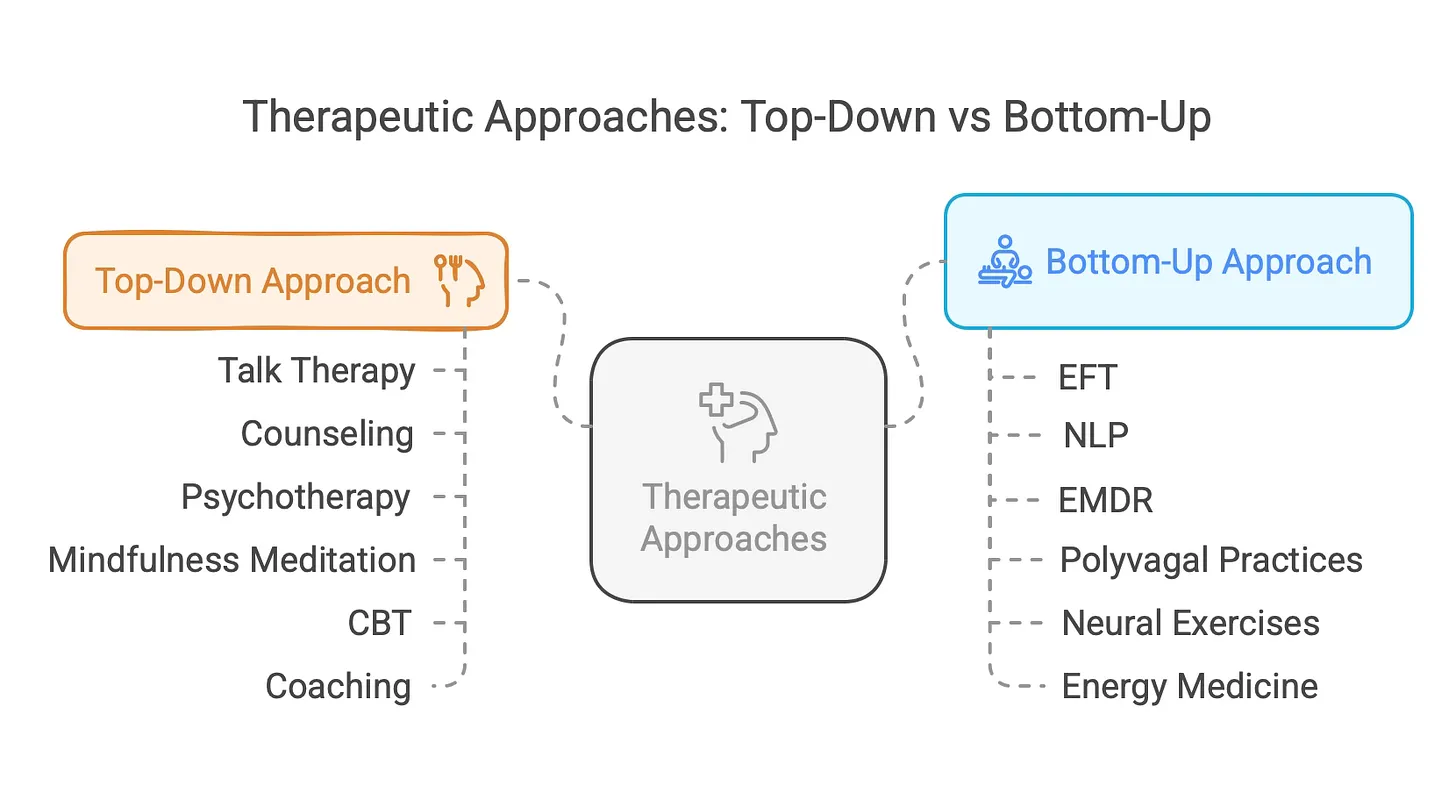
- 1. Top-Down Approaches (Mind-First)
- 2. Bottom-Up Approaches (Body-First)
- Why Top-Down Approaches Alone Often Fall Short
- Understanding EFT Tapping and Bottom-Up Processing: What Trauma Therapy Research Says
- The Limits of Mindset Work
- Why EFT Tapping and Bottom-Up Trauma Therapy Create Deeper Emotional Healing
- What This Means For You
- A Simple Tool for When Overwhelm Takes Over
- Moving Forward with Compassion
The Two Paths to Change: Top-Down vs. Bottom-Up
When it comes to personal growth and emotional healing, we typically see two main approaches:
1. Top-Down Approaches (Mind-First)
These methods focus on using conscious thought and cognitive awareness to shift emotions and behavior.
Common Top-Down Methods:
-
Talk therapies like CBT and DBT
-
Positive affirmations
-
Mindfulness meditation and visualization
-
Journaling and reflective writing
-
Mindset coaching
How They Work:
-
Help you recognize and reframe limiting beliefs
-
Provide logical strategies to reinterpret emotions
-
Promote clarity and self-awareness
These methods can be incredibly helpful—especially if you're naturally reflective and enjoy problem-solving. But they tend to assume that insight alone leads to transformation, often overlooking the physiological roots of emotional responses.
In fact, a major study found that talk therapy alone led to significant improvement in just 44% of participants with trauma-related symptoms (Bradley et al., 2005). Researchers concluded that body-based methods were likely necessary for deeper healing.
2. Bottom-Up Approaches (Body-First)
Bottom-up approaches begin with the body—focusing on regulating the nervous system and working with physical sensations—before engaging the thinking mind.
Common Bottom-Up Methods:
-
EFT Tapping: A fast, accessible emotional freedom technique that involves tapping on specific points on the body while focusing on emotional distress. This powerful tool combines elements of cognitive therapy with gentle pressure on specific acupuncture points, creating a tapping sequence that sends calming signals to the nervous system, reduces stress, and resolves emotional patterns at their root. EFT tapping can help with immediate relief while supporting long-term emotional balance and resilience.
-
EMDR: Uses eye movements to help reprocess traumatic memories.
-
Polyvagal Practices: Engage the vagus nerve to promote safety and connection.
-
Breathwork: Uses specific breathing patterns to reset the nervous system.
How They Work:
-
Regulate fight/flight/freeze responses at the physiological level
-
Release stored emotional tension through movement or sensation
-
Create the conditions for natural emotional and cognitive shifts
Bottom-up techniques acknowledge that emotional responses aren't just in your head—they're stored in your body. That's why "understanding" anxiety doesn't necessarily stop your heart from racing or your stomach from tightening in stressful situations.
Among these methods, EFT Tapping stands out as both highly effective and accessible. It bridges the gap between mind and body—offering immediate relief and supporting long-term emotional balance.

Why Top-Down Approaches Alone Often Fall Short
We're often taught that understanding our triggers should lead to change. But your nervous system doesn't wait for logic.
A pivotal study in Neuroscience showed that the amygdala—your brain's fear center—responds 200 milliseconds before the thinking brain (prefrontal cortex) has time to kick in.
LeDoux & Pine, 2016
The Brain's Stress Response Hierarchy:
-
Survival Brain (Brainstem) – automatic, instinctual responses
-
Emotional Brain (Limbic System) – stores emotion and memory
-
Thinking Brain (Prefrontal Cortex) – responsible for logic and reasoning
In moments of stress, the survival brain jumps in first. So, even if your logical brain knows you're safe, your body may still react with sweaty palms, racing thoughts, or a fight-or-flight response.
Example: You're well-prepared for a big meeting, but as it begins:
-
Survival Brain: Kicks in with a racing heart and shallow breath
-
Emotional Brain: Connects the situation to past fear or judgment
-
Thinking Brain: Tries to reason ("You're fine!")—but it's already behind
This is why rational thinking alone often can’t stop a stress response because your body reacts first.
For those struggling with anxiety or depression, this automatic stress response shows why addressing only thoughts or talk-based strategies may fall short. Trauma-informed EFT tapping works directly with the nervous system, helping reduce anxiety while promoting emotional regulation through integration of body and mind.
Understanding EFT Tapping and Bottom-Up Processing: What Trauma Therapy Research Says
Clinical Evidence Supporting Body-Based Trauma Therapy:
-
EFT's Impact on Anxiety: Using EFT tapping reduced anxiety by 40% in a single session (Journal of Nervous and Mental Disease, Church et al., 2018)
-
Physiological Effects: This emotional freedom technique shows measurable cortisol reduction and improved heart rate variability (Psychological Trauma, Church et al., 2014)
-
Long-Term Results: 86% of participants using EFT maintained improvements after 6 months, compared to 27% with traditional therapy alone (Clond, 2016)
Dr. Stephen Porges' Polyvagal Theory adds further insight, showing how EFT tapping and other trauma therapy techniques help shift the nervous system from a threat response to a state of calm and connection (Porges, 2017; 2022). This biological shift through nervous system regulation explains why emotional freedom technique approaches like EFT can create meaningful emotional healing so quickly.
The Limits of Mindset Work
Mindset work shines when the nervous system is already calm. But during stress, the brain enters defense mode, and top-down strategies often fall flat—or even feel invalidating.
-
In a calm state: Affirmations and reframing can feel empowering.
-
In a dysregulated state: The same tools might feel forced or ineffective.
This is where many people feel stuck. They're not doing anything "wrong"—they're simply trying to change their thoughts when their nervous system isn't ready.

Why EFT Tapping and Bottom-Up Trauma Therapy Create Deeper Emotional Healing
Rather than fighting your body's survival responses, trauma therapy techniques like EFT tapping work with them. They regulate the nervous system first, making it easier to manage stress and address emotional issues naturally.
EFT involves tapping on specific points along the body while focusing on emotional distress. This emotional freedom technique combines elements of cognitive therapy with gentle pressure on specific acupuncture points, creating a tapping sequence that sends calming signals to your nervous system.
The Power of using EFT for Nervous System Regulation:
-
Reduces cortisol (your primary stress hormone) by 43% in a single session (Church et al., 2019)
-
Addresses chronic pain, negative emotions, and trauma through gentle pressure on specific points
-
Helps deactivate fight-or-flight responses while promoting the mind-body connection (Levine, 1997)
-
Shifts the nervous system into a state of safety and connection (Porges, 2022)
EFT works by gently resetting your nervous system, creating the safety your body needs for real healing. Whether used for immediate relief or deeper emotional healing, this accessible method helps align your mind and body—without requiring special equipment or clinical settings.
Bottom-up techniques like EFT Tapping works by gently resetting the nervous system, creating the safety your body needs for emotional change and real healing. Whether used for immediate relief or deeper emotional healing, this accessible, self-applied method helps align your mind and body—without requiring special equipment.

What This Means For You
Understanding how your nervous system processes emotions through trauma and anxiety empowers you to choose the right therapeutic tools for deeper emotional healing.
Research-Based Benefits of EFT Tapping and Body-Based Trauma Therapy:
-
For Anxiety and Depression: Combining EFT with traditional therapy reduces symptoms twice as effectively, helping calm the nervous system while addressing negative emotions (Clinical Psychology Review, Mavranezouli et al., 2020)
-
For Stress Management: Studies show that just 10 minutes of tapping specific points can trigger measurable cortisol reduction, making EFT a powerful tool for immediate relief from emotional distress (Church et al., 2012)
-
For Emotional Regulation: A meta-analysis of 20 studies showed that people using emotional freedom technique and other body-based approaches reported significantly better emotional balance than those using cognitive strategies alone (Feinstein, 2019)
When Bottom-Up Approaches Work Best:
-
When thinking alone doesn't change how you feel
-
When anxiety or stress feels "stuck" in your body, no matter how much you try to think differently
-
When old experiences still trigger physical reactions, even if you've "moved on" mentally
-
When traditional talk therapy hasn't created lasting results
A Simple Tool for When Overwhelm Takes Over
When that familiar stress response kicks in, having practical tools can make all the difference. This free EFT guide teaches you gentle tapping techniques to help calm your nervous system when those overwhelming feelings surface. It's one practical tool in your toolbox - not a magic solution, but something that can genuinely help you find relief in the moment.
Moving Forward with Compassion
If you've been working hard to feel better and still find yourself stuck in patterns of anxiety, emotional overwhelm, or trauma responses, you're not alone—and it's not a sign that you're doing anything wrong. Sometimes, the path forward means gently shifting how you approach emotional healing through nervous system regulation.
Your nervous system has its own timeline and wisdom. While cognitive approaches focus on understanding why you feel stuck, trauma therapy techniques like EFT tapping meet your body where it is and create the safety needed for genuine transformation. This emotional freedom technique acknowledges that healing involves both body and mind, creating lasting change through gentle, accessible methods that promote resilience and emotional well-being.
Remember, there's no timeline for healing, and there's no "right" way to feel better. Your body has been doing its best to protect you, and now you have tools to work with it rather than against it. Trust your own pace, honor what feels right for your nervous system, and be patient with yourself as you explore these body-based approaches.
You don't need to push harder to rise higher. You just need the right tools—and the understanding that your body's wisdom has been guiding you all along.
With warmth and encouragement,
🌿 Kay

P.S. Your nervous system deserves this gentle approach, and so do you. In upcoming posts, I'll be sharing more practical ways to integrate bottom-up healing into your daily life. Make sure you're subscribed so you don't miss these insights that could be the missing piece in your healing journey