3 trauma-informed steps to break the cycle gently (without burning out or beating yourself up)
Do you ever feel like you should be further along in your life by now?
You make the plan. You know what would make you feel better, more fulfilled, more confident. You even start strong…
Then something happens.
You lose momentum. You "fall off track." You slip into old patterns that feel frustratingly familiar.
You eat what you said you wouldn't. You scroll when you swore you'd focus. You clean the kitchen instead of working on the thing that actually matters.
And afterward? You feel disappointed, deflated—and sometimes even a little ashamed.
Maybe you:
-
You plan a healthy week of meals… and by Wednesday, you’re eating takeout and feeling frustrated with yourself.
-
You set aside time to work on your project… and after two productive days, you suddenly procrastinate on the one thing that matters most.
-
You commit to a new habit or routine… and just when it feels like it’s sticking, you “forget” or skip a step and start over.
-
You say you’ll finally set that boundary… and after a few successes, old patterns creep in and you say “yes” again.
-
You promise yourself a calm, structured day… but a small distraction or emotional trigger sends you off track, leaving you doubting your ability to follow through.
And when this keeps happening, it's easy to wonder: What's wrong with me?

Especially when everyone else sees you as the one who "has it all together."
But behind that picture-perfect façade, you're exhausted from trying so hard, only to land in the same spot again.
You try harder. You write the to-do list. You find the next productivity system, the next calendar app, the next 5 AM wake-up routine…
But instead of getting traction, you spin.
And if you're being honest, it's exhausting. It's confusing. And honestly? It can feel a little heartbreaking.
Because deep down… you want more for your life.
You feel the version of you that could be showing up. But you don't know how to get there—at least, not consistently.
It feels like no matter how much you want to move forward… some invisible part of you is quietly pulling the brakes.
This blog post is for you if:
-
You're tired of getting excited about goals that never fully land
-
You feel like you're doing everything right—but still not getting results
-
You've spent years supporting others, but now want to finally show up for yourself
Here's the truth: This isn't about willpower.
It's not about needing more discipline, motivation, or color-coded schedules. It's about what's happening underneath your surface-level habits.
Let's talk about what's really behind self-sabotage—and what finally helps you shift it from the inside out.

Table of Content
- 3 trauma-informed steps to break the cycle gently (without burning out or beating yourself up)
- This blog post is for you if:
- Imagine Something Different
- You're Not Alone in This
- So What's Really Going On?
- Why you might be self-sabotaging
- 1. Hidden Benefits of Staying Stuck (Secondary Gains)
- 2. Fear of Success (and Everything That Comes With It)
- 3. Old Beliefs That No Longer Serve You (Outdated Inner Programming)
- The Myth of Motivation
- The Elephant 🐘 and the Ant 🐜: A Visual Metaphor
- Willpower vs. Subconscious Programming
- The Self-Sabotage Stress Cycle
- The Self-Sabotage Cycle Looks Like This:
- Three Life-Changing Steps to Stop Self-Sabotaging Behavior
- Step 1: Awareness + Release = Real Change
- Step 2: Rewiring Your Inner Compass
- Step 3: Meeting Your Inner Protector
- Why This Step-by-Step Approach Actually Works
- Why Knowing Isn’t Enough
- How I Guide Women Through Deep, Lasting Change
- You Might Be Wondering...
- "But what if this is just who I am?"
- "What if I've tried everything and nothing works?"
- Your Toolkit for Change
- Picture Your Life Six Months From Now
- And If Doubts Sneak In…
Imagine Something Different
-
You wake up feeling calm and grounded—not already behind.
-
You follow through on your commitments—not because you're forcing yourself, but because it feels natural.
-
You follow through on your commitments—not because you're forcing yourself, but because it feels natural.
That's what becomes possible when you stop treating self-sabotage like a willpower problem—and start working with your nervous system instead of against it.
In this post, I'll share three gentle but powerful steps to help you shift out of chronic self-sabotage, reconnect with your inner safety, and finally follow through on what matters most to you.
You'll also learn about a deeper emotional loop I call the Self-Sabotage Stress Cycle—and how to break free from it for good.

You're Not Alone in This
If you’ve ever started strong… only to stumble right when things should be clicking—you’re not alone.
One client struggled to do something as simple as having a consistent morning routine—quiet time, journaling, and a cup of coffee. For two days, it worked beautifully… then she found herself slipping back into old habits: sleeping in when she could, scrolling her phone, skipping her routine, and feeling frustrated. This pattern had been repeating for a long time. It was slowly eating away at her self-confidence, and she couldn’t understand why it was so hard to show up for herself. Through our sessions, she uncovered why she kept resisting this time for herself.
"I thought I was just lazy or undisciplined. Once I understood what was really going on, it felt natural to honor my own needs."
Another client was determined to get back to regular exercise. For two or three weeks, she followed her plan perfectly—morning workouts, feeling proud, seeing small progress. But then, something would trigger old patterns: a busy day, extra tiredness, or just the mental pushback she wasn’t expecting. Suddenly, the workouts stopped completely, and she felt frustrated, disappointed, and like she’d failed herself all over again.
Through our sessions, she discovered that her body and mind had been unconsciously protecting her from burnout. Once she learned how to work with those patterns instead of against them, she was able to return to her routine consistently—without guilt or shame.
"I always thought I just couldn’t stick to a plan. Now I understand why I kept falling off—and it feels so much easier to follow through."

Another client wanted to cut back on weekday wine. For a week or two, she succeeded—swapping in tea in the evenings, feeling proud of her discipline. But then stress, fatigue, or social triggers would creep in, and before she knew it, she was pouring a glass midweek and feeling guilty afterward.
In our sessions, she uncovered that drinking wasn’t just a habit—it had become a way to soothe stress and quiet self-criticism. Once she understood the pattern and learned how to meet those needs in a healthier way, she could enjoy her evenings without automatically turning to wine, and without the guilt cycle.
"I used to think I just didn’t have self-control. Now I see what I was really trying to do—and I feel free to make different choices without beating myself up."
Self-sabotage looks different for everyone—but the root is often the same: you’re trying to protect yourself. The breakthrough comes when you learn to respond differently—with insight, compassion, and support.
So What's Really Going On?
On the surface, self-sabotage can look like laziness, flakiness, or a lack of follow-through. But the truth is far more nuanced—and far more understandable.
It’s not about motivation or willpower. It’s about internal conflict.
One part of you wants to move forward—eat better, start that project, make the change. But another part quietly slams on the brakes.
Until that deeper conflict is addressed, you can row hard in a boat that won’t budge—no matter how determined you are.

Why you might be self-sabotaging

Self-sabotage isn’t about laziness, lack of willpower, or not caring. It’s usually about patterns your mind and body learned long ago—patterns that quietly protect you, even when they hold you back.
Here are three common reasons this happens, explained in everyday language:
1. Hidden Benefits of Staying Stuck (Secondary Gains)
Sometimes, staying stuck actually feels safer or easier than moving forward. It might protect you from stress, judgment, or added expectations.
You might notice yourself thinking:
-
“If I stay busy and overwhelmed, no one will expect more from me.”
-
“If I don’t launch this project, I can’t fail.”
-
“If I stay quiet, I won’t get judged.”
These aren’t excuses—they’re survival strategies that worked in the past. Understanding them is the first step toward real change.
Healing isn’t just about pushing harder. It’s about understanding why your brakes were on in the first place.
2. Fear of Success (and Everything That Comes With It)
Often, it’s not failure we fear—it’s the consequences of success. Success can bring more expectations, visibility, or responsibility than we’re ready to handle.
You may find yourself asking:
-
“If I succeed, will people expect even more from me?”
-
“Will I be rejected or judged for standing out?”
-
“Will I burn out trying to maintain it?”
Your nervous system values safety. Until success feels safe, it will quietly push back.
3. Old Beliefs That No Longer Serve You (Outdated Inner Programming)
Your subconscious may still be running on old messages from childhood or past experiences, such as:
-
“I’m not good enough.”
-
“If I succeed, I’ll be alone.”
-
“Being visible isn’t safe.”
Trying to override these beliefs with “just do it” energy or affirmations doesn’t usually work. The surface may appear fine, but the root issue remains.
True transformation happens when you address the underlying patterns, not just the behavior on the surface.

The Myth of Motivation
The Elephant 🐘 and the Ant 🐜: A Visual Metaphor

Imagine an enormous elephant walking forward. On its back is a tiny ant, doing its best to steer in the opposite direction.
The ant is your conscious mind—your logic, your goals, your action plans.
The elephant is your subconscious—your memories, emotional experiences, and deeply embedded protective strategies.
Here's the problem: If your elephant (subconscious) associates success with danger, rejection, criticism, or burnout—it will not go there, no matter how much your ant (conscious mind) wants it.
You can try to force the elephant through sheer willpower… but eventually, the elephant always wins.
Willpower vs. Subconscious Programming
Trying to succeed without addressing your subconscious beliefs is like steering a boat set on autopilot.
Sure, if you grip the wheel tight enough, you can force it in another direction for a while. But the moment you get tired, distracted, or overwhelmed? Autopilot takes over.
Back to procrastination. Back to emotional eating. Back to overthinking and underperforming.
Self-sabotage isn't failure. It's autopilot.
The Self-Sabotage Stress Cycle
Here’s something I see all the time—especially in high-achieving, emotionally aware women:
They’re not flaky. They’re not lazy. They’re stuck in a cycle they don’t even realize they’re in.
I call it the Self-Sabotage Stress Cycle—and once you see it, you’ll start to understand why things always seem to fall apart right when they start to work.
The Self-Sabotage Cycle Looks Like This:
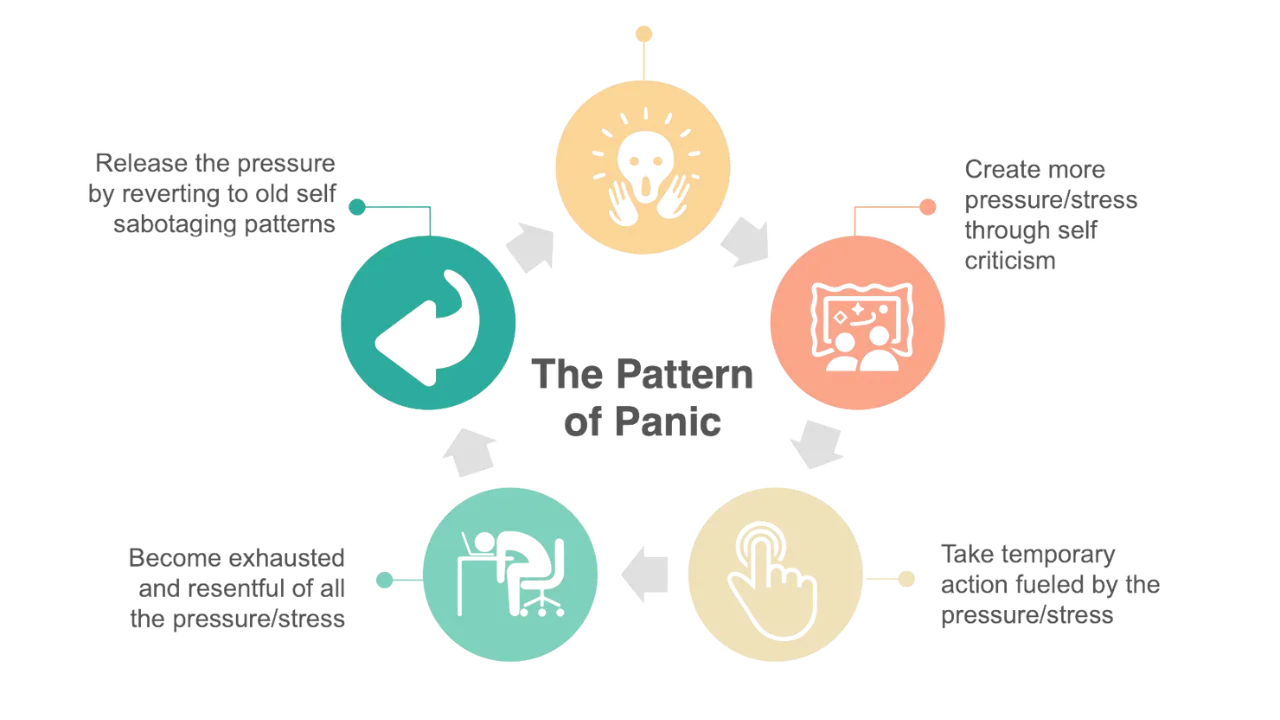
1. Pressure to Perform
You start with good intentions. You want to do it right. Be excellent. You pile on expectations, perfectionism, or comparison. Your inner critic starts barking.
2. Pushing Through
You try harder. You over-function. Take care of everyone and everything. You may feel productive… but underneath, the stress is building.
3. Crash
Eventually, your body and mind can’t keep up. Fatigue, burnout, or physical tension hits. Motivation drops. Frustration rises.
4. Guilt & Shame
Now you feel bad for crashing. “I should have known better. I should have done more. ”That self-criticism just adds to the stress.
5. Slipping Back
To cope, you fall back into the things you promised you wouldn’t do.Overeating. Overcommitting. Numbing out. Shrinking back.
6. The Pressure Creeps Back In
Your inner critic revs up. You make a new plan. Start over—harder this time.And the cycle begins again.
Sound familiar?
The good news is: this cycle can be broken. Not through willpower or pushing harder, but by working with your nervous system, not against it.
Here are three gentle but powerful steps that help my clients (and myself) finally exit this cycle—for good.
Three Life-Changing Steps to Stop Self-Sabotaging Behavior
Here are three powerful but gentle steps I walk clients through again and again—because they work.
Not because they force you to “push through,” but because they help your whole system feel safe moving forward.
These aren’t mindset hacks. They’re emotional and body-based shifts that create real, lasting change from the inside out.
Step 1: Awareness + Release = Real Change
Many women I work with already know they’re self-sabotaging. They’ve journaled about it. Taken courses. Done the inner work.
And yet—nothing sticks. Why?
Because awareness alone isn’t enough.
It’s like spotting the anchor on a boat… but still not being able to lift it.
Often, your body is still running an old protective pattern. It senses “danger” in change, so it quietly pulls you back—no matter how much your mind wants to move forward.
Emotions like fear, shame, or “not enoughness” don’t just live in your thoughts. They live in your body.
When we use Clinical EFT, those stuck responses finally have a safe way to release—without having to relive old pain.
Many clients describe it as “finally exhaling after years of holding my breath.”
Step 2: Rewiring Your Inner Compass
Think of it this way: your conscious mind is like an ant. Your subconscious is like an elephant.
No matter how determined the ant is, if the elephant is afraid—of success, visibility, or rejection—it will quietly steer you away.
Tapping helps the elephant feel safe. It creates a bridge between the part of you that wants to move forward and the part that’s afraid of what might happen.
Instead of trying to argue with yourself or “just push harder,” tapping goes straight to the emotional center of your brain—the part that decides if something feels safe.
When that part settles, you no longer have to fight yourself. Progress feels natural.
Step 3: Meeting Your Inner Protector
That inner voice whispering:
-
“You’ll mess this up.”
-
“You’re not ready.”
-
“It’s safer not to try…”
That’s not sabotage. That’s protection.
Through Parts Work, we gently connect with the part of you that’s been carrying fear or pain. Instead of silencing it, we listen.
✨ Why This Works: These inner protectors aren’t trying to ruin your progress. They’re trying to keep you safe with strategies that worked in the past.
When you meet them with compassion instead of shame, they soften. And when they feel safe, they evolve—freeing you to move forward without the constant inner battle.
The real shift happens when your mind, body, and emotions are no longer working against each other.
When all parts of you feel safe and supported, follow-through stops being a struggle. It starts to feel like the most natural thing in the world.
Why This Step-by-Step Approach Actually Works
Most self-help advice tells you to push harder. To force new habits. To repeat the affirmations until they stick.
But if that worked, you’d already be where you want to be.
The truth is: you don’t need more pressure. You need a process that works with your body, your brain, and your emotions.
This approach works because it meets you where the real blocks live:
-
Not in your to-do list… but in your nervous system
-
Not in your good intentions… but in your emotional memory
-
Not in surface habits… but in the parts of you that never felt safe enough to fully show up
Why Knowing Isn’t Enough
Here’s what most people don’t realize:
The part of your brain that knows what to do (say no, stick to goals, make healthy choices) isn’t the part that calls the shots when stress hits.
✨ That’s why you can know better… and still not do better.
✨ That’s why affirmations can fall flat.
✨ That’s why willpower only lasts so long.
Real change happens when you start working with the part of your brain and body that’s actually in charge in those moments.
If you’re curious about trying a science-backed way to gently interrupt self-sabotage, I’ve created a practical EFT Tapping Guide. Inside, you’ll find step-by-step instructions and tools you can use whenever those old patterns show up.
It’s there to support you at your own pace—no pressure, just a resource for calmer, more authentic progress.
How I Guide Women Through Deep, Lasting Change
The women I work with are done with pushing through resistance and calling it growth.
They want:
-
Emotional clarity without overthinking
-
Deep release without reliving trauma
-
Real progress without self-betrayal
Using a blend of Clinical EFT, nervous system work, and parts-based healing, I guide them to:
-
Release protective emotional patterns (without pressure)
-
Uncover the hidden roots of self-sabotage
-
Build inner safety so follow-through feels natural
It’s not about fixing yourself. It’s about finally feeling safe enough to be yourself.
When your nervous system is no longer fighting your goals, success stops feeling like a threat. Self-trust deepens. And following through stops being a struggle—it becomes who you are.
You Might Be Wondering...

"But what if this is just who I am?"
If you’ve been stuck in people-pleasing, perfectionism, or self-sabotaging patterns for years, it may feel like this is just your personality.
You might think:
-
“I’m just not someone who follows through.”
-
“I always start strong and then fall apart.”
-
“I’m the kind of person who burns out.”
Here’s the truth: what you’ve been calling “just who I am” is often “how I learned to stay safe.”
And that can change. Not through shame. Not through more pressure. But through presence, compassion, and tools that work with your nervous system.
"What if I've tried everything and nothing works?"
That’s such a valid fear.
If you’re here, you’ve probably already tried the planners, the productivity hacks, the mindset work—maybe even therapy.
The problem? Most of those approaches target behavior, but not the nervous system patterns driving the behavior.
It’s like trying to quiet a smoke alarm by opening a window, instead of putting out the fire.
EFT works differently. It calms the emotional brain—the part that holds old protective patterns. When that part no longer feels in danger, resistance melts. Motivation returns. Action feels natural, not forced.
Your Toolkit for Change
If you’ve read this far, take a breath.
You’ve already taken the most important step: awareness without judgment.
You’re no longer seeing self-sabotage as laziness or failure. You’re starting to see it for what it really is: a protective pattern ready to be updated.
Here’s what you now know:
🌿 Self-sabotage isn’t a willpower problem—it’s a nervous system response.
🌿 Pushing through doesn’t solve it—safety does.
🌿 The root lives deeper than logic—and that’s where real change begins.
You’ve also discovered:
-
What the Self-Sabotage Stress Cycle looks like (and how it keeps you stuck)
-
How inner protectors often show up as procrastination, perfectionism, or “falling off”
-
Why tools like tapping (EFT), parts work, and emotional release create safety so you can move forward
These aren’t quick tips. They’re tools for real, embodied change.
You don’t have to become a different person. You don’t have to fix yourself. You simply get to lead yourself with compassion, clarity, and safety.
You’re not behind. You’re becoming. And you don’t have to do it alone.
Picture Your Life Six Months From Now

Take a breath. Soften your jaw. And picture this:
✨ Six months from now…
You wake up calm—not behind.
You follow through without the inner battle.You’re nourishing your body—not punishing it.
You’re making progress that actually lasts.
There’s space in your schedule.
There’s space in your body.And—maybe for the first time in a long time—there’s space in your mind.
Now imagine yourself there:
-
How are you moving through your day?
-
What does your voice sound like?
-
What does your nervous system feel like?
This isn’t a fantasy. It’s what becomes possible when your body feels safe to change.
And If Doubts Sneak In…
Maybe you hear:
-
“This won’t happen for me.”
-
“I never stick with anything.”
-
“What if I can’t handle it?”
That’s not failure. That’s your survival brain doing its job—predicting disappointment and pulling you back to your comfort zone.
But here’s the truth: You can believe in success… but if your body doesn’t feel safe to have it, it will keep sabotaging in subtle ways.
The good news? Once you see those doubts for what they are—outdated protection—you can start to release them. With tapping. With compassion. One layer at a time.
It’s so common to feel frustrated when old patterns play out—especially when you know better, but can’t seem to do better. But you’re not alone, and nothing about you is broken. Every protective loop you notice has roots in past experience, and every moment of awareness is a step toward lasting change.
Whether you take small steps on your own, reach out for support, or just practice a little more kindness with yourself today, you’re moving forward. Your progress isn’t erased by setbacks, and your courage is already enough.
With understanding and gentle encouragement,
🌿 Kay