
Do you ever feel like no matter how much you achieve, that feeling of 'not enough' still lingers? Maybe you're feeling anxious about your capabilities, or that inner critic keeps you trapped in cycles
Maybe you're checking off goals, showing up for others, and doing all the "right" things—but deep down, there's still that lingering worry that someone's going to figure out you're not really qualified.
Maybe you're constantly questioning whether you're good enough, smart enough, or experienced enough… even when others clearly believe in you.
Maybe no matter how much reassurance you get, your inner critic still talks louder than any compliment ever could.
And maybe—just maybe—you're tired. Tired of the second-guessing. Tired of feeling like you're constantly proving yourself. Tired of the voice in your head that never seems to let up.
If this sounds familiar, I want you to know: you're not alone—and you're definitely not broken.

Table of Content
- The Daily Toll of a Loud Inner Critic
- Why It's So Hard to Just 'Be Confident' (and Why That's Not Your Fault)
- What's Possible When You Do This Work
- Your 3-Step Roadmap to Freedom
- Step 1: Tame the Inner Critic (Don't Let It Run the Show)
- Step 2: Release Emotional Triggers
- Step 3: Build Confidence Through Vulnerability
- You Might Be Wondering... "What If This Doesn't Work for Me?"
- A Gentle Tool to Get Started
- You Deserve to Feel Confident, Capable, and Calm
- Your Journey Forward
The Daily Toll of a Loud Inner Critic
When you live with self-doubt as a constant background hum, it doesn't just stay in your head. It seeps into the way you move through life:
You turn down meaningful opportunities—like speaking up in meetings or saying yes to a promotion—because part of you fears being "found out" as not truly capable.
You second-guess your words after conversations, replaying what you said and wondering if you sounded awkward, unqualified, or too much.
You brush off praise or support, assuming people are just being polite or don't really know you well enough to see your flaws.
Over time, this creates a cycle. You hold back → you feel regret → your inner critic pipes up → you resolve to try harder → and the cycle repeats.
All of this not only drains your energy, but it also keeps you from stepping fully into the roles, relationships, and goals that actually light you up. And the hardest part? You may have no idea why this pattern won't break—especially when you're actively trying to "think positively" or "believe in yourself."

Why It's So Hard to Just 'Be Confident' (and Why That's Not Your Fault)
Here's the truth: This isn't just about mindset. These patterns often go much deeper than that.
Many of us—especially women—have been handed invisible rules since we were young:
-
"Don't make mistakes."
-
"Be nice, but not too outspoken."
-
"You have to work twice as hard to be taken seriously."
-
"It's not safe to show weakness."
-
"If you fail, it means you are a failure."
Add to that the relentless pressure of social media perfectionism, cultural standards around success, and childhood experiences rooted in scarcity or emotional invalidation—and it's no wonder that your inner critic has taken the wheel.
You were likely taught to link your worth to your achievements, your appearance, or how well you please others. So when something goes "wrong" or feels uncertain, your nervous system kicks into high alert, trying to keep you safe by being critical, cautious, or perfectionistic.
It makes total sense. And it's not your fault.
But it is possible to gently unlearn those patterns—and the difference is undeniable.
You start raising your hand for opportunities instead of shrinking away. You speak with clarity and stop apologizing for taking up space. You actually feel your accomplishments—and own them with pride.
You exhale. You soften. You come home to yourself.
What's Possible When You Do This Work
Imagine waking up and not feeling like you have to brace yourself for the day. Imagine speaking in a meeting and not analyzing every word after. Imagine hearing a compliment and actually letting it land.
That's what happens when you quiet the inner critic and shift the stories that fuel imposter syndrome.
When you begin to heal the emotional roots of these patterns, you start to feel:
-
🌱 Lighter—as if you've been carrying around invisible weight for years and are finally setting it down.
-
💬 More confident—not because you're perfect, but because you trust yourself more.
-
🌊 More at ease—less hustle, more flow. You stop chasing worthiness and start living it.
And it's not about becoming someone new—it's about coming back to yourself.

Your 3-Step Roadmap to Freedom
So how do you actually begin to shift this? Let's walk through three supportive, proven steps that help you break the cycle of self-doubt and come home to yourself—gently, and at your own pace:
-
✔️ Tame your inner critic
-
✔️ Release emotional triggers
-
✔️ Build confidence through vulnerability
You don't have to stay in survival mode. Let's explore how to gently interrupt the cycle and return to a place of peace, clarity, and confidence.
Ready to begin? Let's dive in.
Step 1: Tame the Inner Critic (Don't Let It Run the Show)
Let's start with that voice in your head that always seems to have something critical to say.
For many women, this voice isn't just background noise—it's loud, relentless, and deeply tied to the fear of being "found out" or not measuring up. It whispers doubts in your highest moments and replays your mistakes in your quietest ones.
It's that voice that says, "You're not ready," or "You don't know what you're doing," even when there's evidence that you're more than capable.

Understanding Your Inner Critic
Here's the thing: Your inner critic is not the truth—it's a learned voice, shaped by past emotional experiences, limiting beliefs, and nervous system survival instincts that keep you feeling stuck in patterns of low self-confidence.
Your inner critic is not your truth. It's a learned voice—often rooted in old pain, fear, or beliefs you never chose.
The first step is recognizing that this voice is just a part of you—not all of you. And when you can name it, pause, and respond differently, something powerful begins to shift.
How EFT Tapping Transforms Your Inner Dialogue
This is where EFT tapping techniques come in. Unlike just trying to "think positively," these emotional freedom techniques help you regulate your body's stress response in real time—calming your nervous system while releasing the emotional blocks and limiting beliefs that fuel anxiety and self-doubt.
You might begin with a tapping phrase like: "Even though part of me thinks I'm not good enough, I'm open to seeing myself with more kindness."
When you tap while acknowledging self-critical thoughts, you're signaling to your body: "I'm safe. I don't have to stay in survival mode. I can choose a new way."
When you tap while acknowledging self-critical thoughts, you're signaling to your body: "I'm safe. I don't have to stay in survival mode. I can choose a new way."
Real Results: Emma's Transformation
Take my client Emma, for example. She used to dread team meetings—not because she didn't have ideas, but because she constantly second-guessed herself after speaking up. She'd replay every word, worrying she sounded "too much" or "not smart enough."
But once we started working together using EFT and Inner Child Work, things shifted.
Through this inner work, she began to recognize that the part of her feeling anxious and lacking confidence was actually a younger version of herself—scared of being judged or rejected. The EFT tapping techniques helped her nervous system feel safe enough to release these old emotional patterns. And for the first time, she stopped tearing herself apart after speaking.
Her inner critic didn't disappear overnight—but it lost its grip. And in its place, her confidence began to take root.
Step 2: Release Emotional Triggers
Have you ever had a seemingly small moment trigger a big wave of insecurity, anxiety, or that familiar feeling of low self-confidence? Maybe someone gives you feedback and suddenly your nervous system activates and your chest tightens, or you see someone succeeding and those limiting beliefs about not being good enough surface.
These are emotional triggers—and they're gold mines for healing.
Why Triggers Are Actually Gifts
Here's the truth: These emotional triggers don't mean you're overreacting. They're simply signposts, pointing to deeper patterns, limiting beliefs, and past emotional experiences that want to be acknowledged and released through gentle inner work.
When you process these reactions rather than push them away, you break the cycle of reactivity and start building emotional freedom.
In this step, you begin to track the patterns of when and why your self-doubt flares up. You start to connect the dots between present-moment reactions and past emotional wounds. And instead of avoiding or suppressing those feelings, you work with them directly using EFT Tapping.
The EFT Approach to Triggers
For example, during tapping you might say: "Even though I feel that pit in my stomach when someone gives me feedback, I understand it's linked to old fears—and I'm open to feeling safe now."
When you acknowledge the trigger and support your nervous system at the same time, you loosen its grip.
Over time, what used to send you into a spiral starts to feel manageable. You reclaim your emotional bandwidth.
Inner Child Healing Integration
This work is also deeply informed by Inner Child healing—because often, the emotional charge behind a trigger is coming from a younger part of you that needed support and didn't get it.
In private sessions, I guide clients through this exact process. We pinpoint their biggest emotional "hot spots," explore the memories or beliefs driving them, and use a blend of EFT tapping (and sometimes art or journaling prompts) to gently release the fear, tension, and shame stored in those patterns.
The result? You feel clearer, calmer, and more in control—even when life gets messy.
Step 3: Build Confidence Through Vulnerability

Here's a truth that might surprise you: True confidence and emotional freedom don't come from always getting things right or feeling perfect. Real self-confidence comes from accepting yourself fully—including the parts that feel anxious, uncertain, or not good enough.
Confidence doesn't come from being perfect. It comes from being real.
Redefining Strength
So many of us were taught that vulnerability is weakness—that if we show too much softness, uncertainty, or struggle, we'll be seen as less competent. But the truth is, the more you try to hide those parts of yourself, the more your inner critic feeds on them.
What if confidence didn't mean being polished or fearless? What if it meant being fully, unapologetically you—even in the messy moments?
The Vulnerability-Confidence Connection
So the third step is to shift the belief that you have to hide your struggles in order to be seen as strong.
💬 When you allow yourself to be messy, honest, and fully human—you stop feeding imposter syndrome and start growing real, grounded confidence.
In my 1:1 sessions, I guide women through this shift with gentle but powerful practices. We create space for the tender parts of you that feel afraid of being "too much" or "not enough." We use Inner Child Work to heal parts of you that learned to hide your needs, emotions, or mistakes. We pair that with EFT and creative processing tools, so you not only shift how you feel, but also practice showing up in your life with more softness, presence, and power.
Clients often tell me they feel more whole—not because they became someone new, but because they finally accepted who they already were.
You Might Be Wondering... "What If This Doesn't Work for Me?"

Totally fair question.
Many women I work with worry:
"Why is my inner critic still so loud—even when I'm trying to stay positive?"
"What if EFT or Inner Child Work doesn't help me?"
Here's what I want you to know: You're not alone. And there's nothing wrong with you.
Self-doubt isn't something you just "think your way out of." These patterns are often tied to real emotional experiences, messages from childhood, and protective mechanisms your nervous system has built over time.
EFT and Inner Child Work are powerful because they go to the root.
They help you gently release what's been buried or blocked—not by forcing change, but by meeting yourself with care and compassion. And when that happens, things start to shift from the inside out.
A Gentle Tool to Get Started
If this resonates with you and you'd like to explore what it feels like to work with your inner critic in a new way, I've created a simple EFT tapping guide as a starting point.
"Calm the Inner Critic" Free EFT Tapping Guide
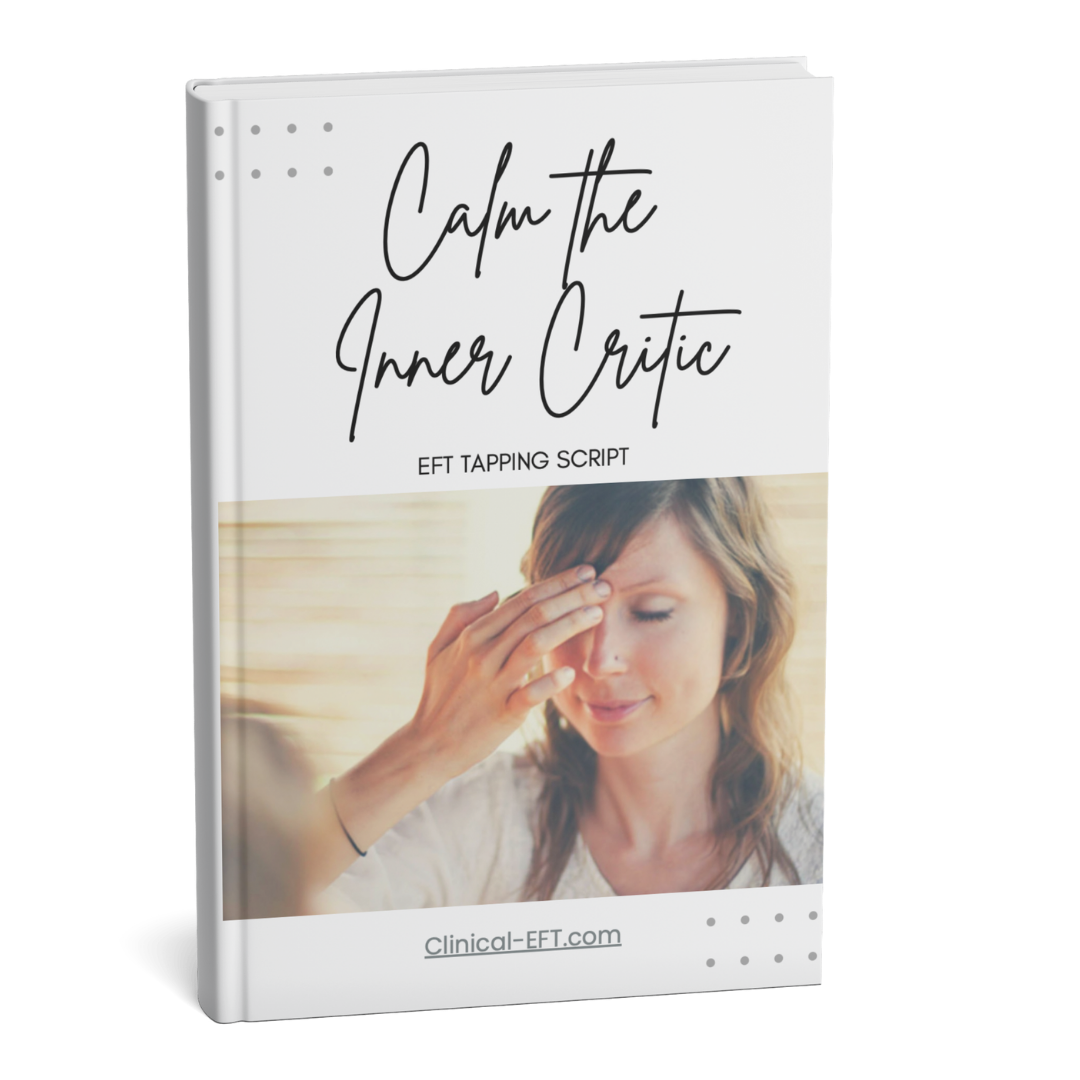
While every person's journey with self-doubt is unique, this guide offers gentle tapping sequences that many women find helpful when that critical voice gets loud. It's designed to give you a taste of how EFT can help you respond to self-criticism with more compassion.
This gentle resource includes 11 guided tapping rounds to help you:
-
✓ Release the intensity of self-doubt in the moment
-
✓ Practice speaking to yourself with more compassion
-
✓ Learn the basic EFT technique step-by-step
-
✓ Begin building confidence through self-acceptance
It's one practical tool you can try right now when that critical voice takes over. Not a magic solution, but something that can genuinely help you find your center and explore what it feels like to be gentler with yourself.
You Deserve to Feel Confident, Capable, and Calm
To recap, the path out of chronic self-doubt and imposter syndrome involves three transformative steps:
-
Tame your inner critic using EFT Tapping and compassionate awareness, so it no longer runs your mind or mood.
-
Identify and release emotional triggers so you can respond instead of react.
-
Build emotional resilience and confidence by embracing vulnerability as a strength.
These steps aren't about perfection. They're about creating space to breathe, feel safe in your body, and trust your inner voice again.
When you take these steps, life feels lighter. You stop shrinking. You start showing up.
🌿 You speak up without second-guessing.
🌿 You receive compliments and actually believe them.
🌿 You move through life with clarity, confidence, and calm.
And you begin to see the truth:
You stop chasing a version of "enoughness" that was never yours to begin with—and start creating a life that feels aligned, whole, and true.

Your Journey Forward
Here's what I want you to remember: That inner critic voice doesn't define you. It's not the truth about who you are or what you're capable of. It's simply an old pattern your nervous system learned to keep you safe—and it can be gently transformed.
You don't have to wait until you feel "ready" or until you've figured it all out. Small, consistent steps toward self-compassion create the most lasting change. Every time you choose kindness over criticism, you're rewiring decades of old programming.
Your worth isn't something you need to earn through perfect performance. It's not something that increases with achievements or decreases with mistakes. It's simply yours—because you exist.
Trust the gentle shifts you're already noticing. Honor your own timing. And remember that choosing to be tender with yourself, especially when that inner critic gets loud, is one of the most powerful things you can do.
You're already worthy. You always have been. It's time to let that truth sink in.
With warmth and support,
🌿 Kay